

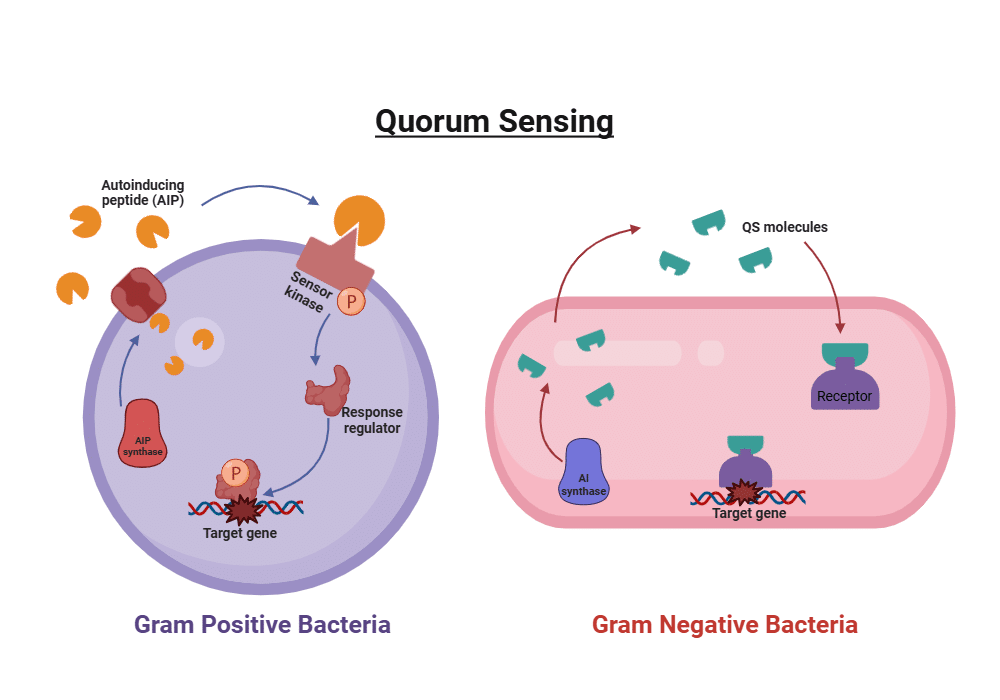

When most people think about food poisoning, they imagine a contaminated meal, a harmful bacterium, and a miserable few days spent recovering from nausea, vomiting, diarrhea, or stomach cramps. The story seems relatively simple: bacteria get into food, someone eats it, and illness follows. Yet beneath the surface, a far more complicated process is often taking place. Many of the bacteria responsible for foodborne illness are not acting alone. They are communicating with one another, coordinating their behavior, and waiting for the right moment to strike.
This phenomenon, known as quorum sensing, has become one of the most fascinating areas of microbiology research over the past several decades. Scientists have discovered that bacteria are far more sophisticated than once believed. Rather than functioning as isolated organisms, many species can send, receive, and respond to chemical signals released by neighboring bacteria. These signals allow entire populations to work together, making collective decisions about when to produce toxins, form protective communities, and launch infections.
While the idea of bacteria “talking” may sound like science fiction, it is a very real biological process. In fact, it may help explain why some foodborne pathogens are so effective at causing illness and why certain contamination problems are so difficult to eliminate.
For years, researchers viewed bacteria as simple single-celled organisms whose behavior was driven almost entirely by their environment. The prevailing assumption was that each bacterium acted independently, responding only to immediate conditions around it. That view began to change when scientists noticed that certain bacterial behaviors only occurred when large numbers of cells were present. A lone bacterium might remain relatively inactive, while an entire population of the same organism would suddenly begin producing toxins or forming complex communities.
The missing piece turned out to be communication.
Many bacteria continuously release small chemical molecules into their surroundings. As more bacteria gather in the same area, the concentration of these molecules increases. Individual cells can detect those signals and essentially measure how many of their neighbors are nearby. Once the concentration reaches a certain threshold, the bacterial population recognizes that it has achieved sufficient numbers to begin acting collectively. Scientists call this process quorum sensing because it resembles the way a group waits until enough members are present before conducting official business.
The strategy makes remarkable sense from the bacteria’s perspective. Imagine a handful of bacteria entering the human digestive tract. If they immediately begin producing toxins or aggressively invading tissues, they risk attracting the attention of the immune system before they have established themselves. A small population can often be eliminated relatively quickly. By waiting, multiplying, and communicating, however, the bacteria can build their numbers before launching a coordinated attack.
When that attack finally comes, it is no longer the effort of a few isolated cells. Instead, thousands or even millions of bacteria activate specific genes simultaneously. Toxins may be produced in greater quantities. Protective mechanisms may be switched on. The bacteria may become more capable of attaching to tissues or surviving hostile conditions. In effect, the population acts as a unified force rather than a collection of individuals.
This ability to coordinate behavior plays an important role in many foodborne illnesses.
Salmonella, one of the most common causes of food poisoning worldwide, provides a good example. Every year, Salmonella infections lead to countless cases of diarrhea, fever, abdominal pain, and hospitalization. Researchers have found that quorum sensing influences several aspects of Salmonella’s ability to establish infection. Once inside the digestive tract, the bacteria use chemical signaling systems to monitor their surroundings and coordinate behaviors that help them survive and spread. Rather than expending energy on aggressive actions immediately, Salmonella can essentially wait until conditions are favorable before activating important disease-causing mechanisms.
Pathogenic strains of E. coli also make use of bacterial communication. While most strains of E. coli live harmlessly in the intestines of humans and animals, certain varieties can cause severe illness. Some strains produce powerful toxins capable of damaging the lining of the intestine and, in serious cases, affecting the kidneys. Research suggests that quorum sensing helps regulate when these toxins are produced. Even more intriguing, some E. coli strains appear capable of responding not only to signals from other bacteria but also to chemical cues produced by the human body itself. In other words, they may be listening to both their fellow bacteria and their host at the same time.
Scientists have described this process as a form of microbial eavesdropping. Although bacteria do not think or plan in the human sense, they can gather information from their environment and alter their behavior accordingly. The result is an organism that is far more adaptable than many people realize.
One of the most significant consequences of quorum sensing is the formation of biofilms. Anyone involved in food safety has likely encountered this term, but many consumers are unfamiliar with it. A biofilm is essentially a community of microorganisms that attach themselves to a surface and surround themselves with a protective layer of material. Within this structure, bacteria can become remarkably difficult to remove.
Biofilms can develop on food processing equipment, drains, conveyor belts, cutting surfaces, storage tanks, and countless other locations throughout food production facilities. Once established, they may persist despite repeated cleaning efforts. In some cases, biofilms become long-term reservoirs of contamination that periodically release bacteria into the surrounding environment.
Quorum sensing plays a major role in making these structures possible. As bacterial populations grow, communication signals trigger the production of substances that help cells attach to surfaces and build the protective matrix surrounding the community. Rather than acting independently, the bacteria work together to construct what amounts to a microscopic fortress.
From a food safety perspective, this presents a serious challenge. Bacteria living within biofilms often display greater resistance to environmental stress, disinfectants, and sanitation procedures. Eliminating them can require significant effort and ongoing monitoring. When investigators encounter recurring contamination problems in food manufacturing facilities, biofilms are frequently part of the story.
Listeria monocytogenes is one pathogen that highlights the importance of these survival strategies. Although Listeria infections are relatively uncommon compared to illnesses caused by Salmonella or Campylobacter, they can be devastating. Pregnant women, newborns, older adults, and individuals with weakened immune systems face the greatest risk of severe complications.
What makes Listeria particularly troublesome is its ability to survive under conditions that would challenge many other bacteria. Unlike most foodborne pathogens, it can continue growing at refrigeration temperatures. It can persist in processing environments for extended periods and, under the right circumstances, establish long-term contamination within a facility. Researchers believe quorum sensing contributes to some of these survival abilities, helping bacterial populations coordinate activities that enhance persistence and resilience.
The more scientists study bacterial communication, the more they realize that the digestive tract is not simply a battleground between pathogens and the immune system. It is an extraordinarily complex ecosystem containing trillions of microorganisms. Collectively known as the gut microbiome, these organisms compete for nutrients, interact with immune cells, and influence a wide range of bodily functions.
When a foodborne pathogen enters this environment, it encounters an already crowded microbial world. Communication becomes an important tool for navigating that landscape. Some bacteria communicate only with members of their own species, while others participate in broader exchanges involving multiple types of microorganisms. These interactions can influence everything from nutrient competition to infection severity.
Researchers are increasingly interested in how quorum sensing may help explain differences in susceptibility to foodborne illness. Two people may consume the same contaminated food, yet one develops severe symptoms while the other experiences only mild discomfort. Numerous factors contribute to these differences, but scientists suspect that variations in the gut microbiome may play a role. The microbial communities already present in the intestine may affect how incoming pathogens communicate, colonize, and establish infection.
Perhaps the most exciting aspect of quorum sensing research is the possibility that it could lead to entirely new approaches for preventing disease. Traditionally, efforts to combat bacterial infections have focused on killing the bacteria themselves. Antibiotics have saved millions of lives, but their widespread use has also contributed to the growing problem of antibiotic resistance.
As resistant bacteria become increasingly common, researchers have begun exploring alternative strategies. One idea is surprisingly simple: instead of killing bacteria, what if we prevented them from communicating?
Scientists are currently studying compounds known as quorum sensing inhibitors. These substances interfere with the signals bacteria use to coordinate behavior. Some block the production of signaling molecules, while others prevent bacteria from detecting incoming messages. Either way, the goal is the same: disrupt communication before harmful behaviors can be organized.
The concept has been compared to disabling a military communication network. The individual participants remain present, but coordinating a large-scale operation becomes much more difficult. If pathogens cannot effectively communicate, they may be less capable of producing toxins, forming biofilms, or establishing successful infections.
Although much of this research remains in the experimental stage, early findings have generated considerable interest. Scientists are investigating compounds derived from plants, marine organisms, and beneficial bacteria that appear capable of interfering with quorum sensing pathways. Some researchers believe these approaches could eventually complement traditional food safety measures and medical treatments.
The implications extend beyond healthcare. Future food safety technologies may focus not only on eliminating bacteria but also on preventing them from organizing harmful behaviors in the first place. By disrupting communication networks, it may be possible to reduce contamination risks, improve sanitation effectiveness, and make food production environments less hospitable to persistent pathogens.
What makes quorum sensing so compelling is that it fundamentally changes our perception of bacteria. These organisms are not intelligent in the way humans understand intelligence, but neither are they the simple, solitary cells they were once believed to be. They exist within communities, share information, and coordinate behaviors that benefit the population as a whole.
Every outbreak investigation, contamination event, and food safety study adds another piece to this picture. The pathogens responsible for foodborne illness are not merely surviving. They are interacting with one another in ways scientists are only beginning to fully understand.
For consumers, quorum sensing may remain largely invisible. No one can see these chemical conversations taking place inside a package of contaminated food or within the digestive tract after a meal. Yet those conversations may ultimately determine whether a bacterial population remains harmless or becomes capable of causing serious disease.
The next major advance in food safety may not come from discovering a stronger disinfectant or a more powerful antibiotic. It may come from learning how to interrupt the signals bacteria rely on to coordinate their actions. If researchers can effectively silence those conversations, they may be able to reduce the ability of dangerous pathogens to organize, survive, and spread.
Food poisoning has always been viewed as a problem of contamination. Increasingly, however, scientists are discovering that it is also a problem of communication. The bacteria that make people sick are often not acting alone. They are working together, exchanging signals, and waiting for the right moment to act. Understanding that hidden language may prove to be one of the most important developments in the future of food safety.
