



An Analysis of Recent International Outbreaks, Epidemiological Case Counts, and Cross-Border Inter-Agency Traceback Interventions
Global Surveillance Overview: Supply Chain Complexities and Rising Pathogen Incidence
Public health monitoring agencies and international regulatory bodies continue to deploy whole-genome sequencing (WGS) and cross-border epidemiologic surveillance networks to track and mitigate foodborne illness outbreaks. Recent surveillance reports released by global public health authorities, including the European Centre for Disease Prevention and Control (ECDC), the European Food Safety Authority (EFSA), the U.S. Centers for Disease Control and Prevention (CDC), and the UK Health Security Agency (UKHSA), indicate that supply chain interdependencies, international commodity trade, and cross-contamination during commercial processing remain primary vectors for pathogen dissemination across international borders.
According to formal surveillance data from EFSA and ECDC, annual foodborne illness outbreaks across European Member States rose to 6,558 incidents, marking a 14.5% year-over-year increase. Human infections associated with these incidents rose to 62,481 reported cases, resulting in 3,336 hospitalizations. Concurrently, multi-agency tracking by the U.S. Food and Drug Administration (FDA) Coordinated Outbreak Response and Evaluation (CORE) network evaluated dozens of prospective contamination events across fresh produce, dairy products, processed goods, and dry packaged shelf-stable items.
| Global Pathogen Surveillance Matrix & Incidence | |||
| Pathogen | Primary Source | Affected Regions | Confirmed Cases |
| Salmonella Enteritidis | Imported Egg Shells | UK/EU | 586+ cases |
| Salmonella Stanley | Instant Noodle Packets | 14 European Nations | 49 hospitalizations |
| E. Coli O26:H11 | Raw Milk and Cheeses | United States | 13 illnesses 8 hospitalizations 3 cases of Hemolytic Uremic Syndrome (HUS) |
| Listeria Monocytogenes | RTE Foods and Cheeses | North America/EU | High severity |
| Clostridium botulinum | Powdered formula | North America | Isolated Cases |
United Kingdom and Europe: Salmonella Enteritidis Outbreak Linked to Imported Shell Eggs
A significant public health investigation coordinated by the UK Health Security Agency (UKHSA) tracked multiple distinct clusters of Salmonella Enteritidis across England, Scotland, Wales, and Northern Ireland. Genomic sequencing and trace-back inquiries conducted by UKHSA and environmental health officers traced the primary contamination source to imported shell eggs distributed through commercial wholesale and catering supply chains.
Epidemiological tracking identified three main genetic clusters originating from the same overarching pathogen line:
- Cluster 1 (t5.9411): Epidemiologists registered 355 confirmed human cases and 1 fatality, with patient sample dates spanning from August 2025 through September 2026.
- Cluster 2 (t0.24068): Testing confirmed 189 illness cases across municipal public health districts, with zero recorded fatalities.
- Cluster 3 (t5.9765): Public health records verified 42 cases and 1 fatality, with sample collection dates continuing into late August 2026.
In total, official UK public health monitoring documented 586 confirmed cases and 2 deaths linked to these three combined clusters. The investigation prompted heightened diagnostic screening at point-of-entry border control posts, alongside mandatory testing protocols for imported poultry products entering the domestic market.
European Continent: Multi-Country Salmonella Stanley Outbreak in Shelf-Stable Goods
In Continental Europe, a multi-jurisdictional outbreak involving Salmonella Stanley (specifically sequence type ST2045) triggered widespread consumer alerts and international product withdrawals across 14 European nations. A joint rapid outbreak assessment published by the European Food Safety Authority (EFSA) and the European Centre for Disease Prevention and Control (ECDC) confirmed human cases across Austria, Czechia, Denmark, Estonia, France, Germany, Hungary, Latvia, Lithuania, the Netherlands, Norway, Poland, Sweden, and the United Kingdom.
Investigation Findings: Microbiological testing conducted by federal food safety laboratories in Germany and Lithuania isolated the outbreak strain within sealed packages of chicken-flavored and hot chicken-flavored instant noodles manufactured at a central processing facility in Ukraine.
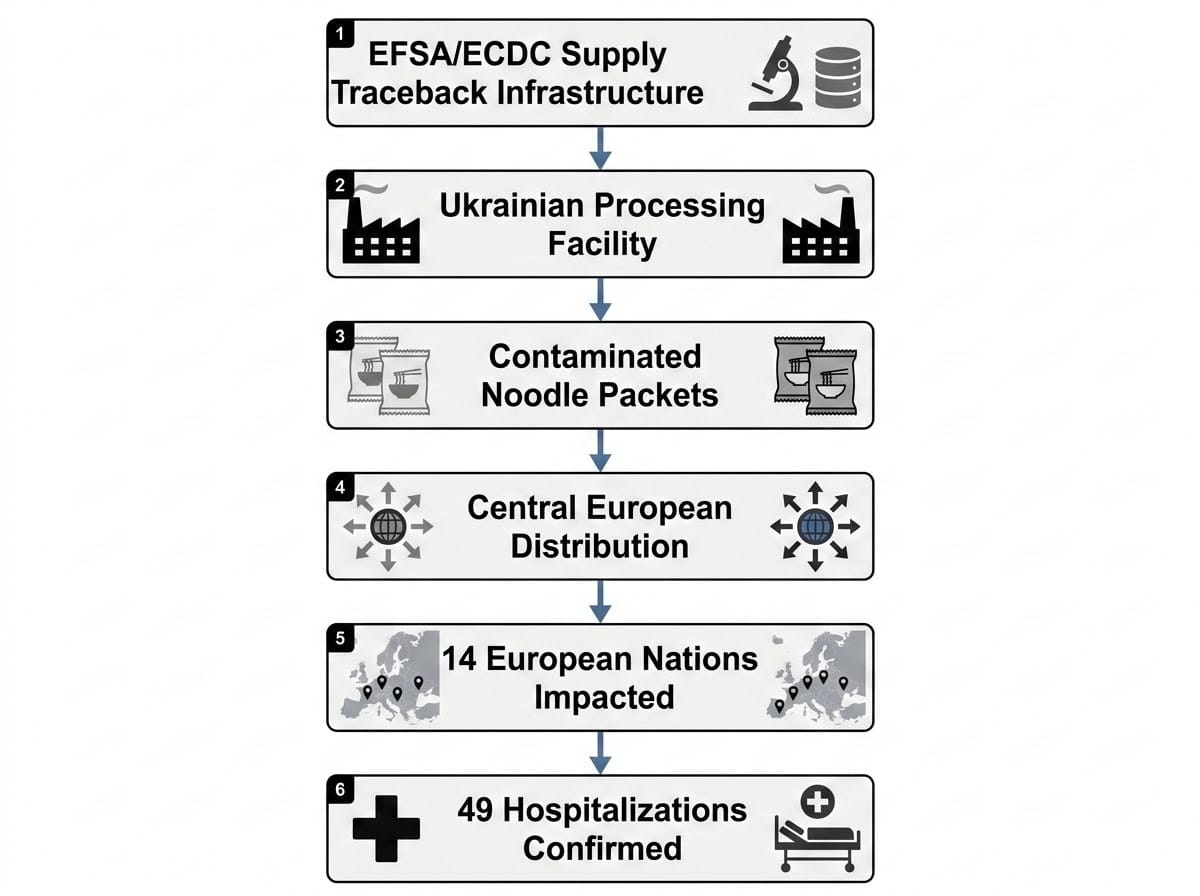
The ECDC reported that at least 49 individuals suffered severe illness requiring acute hospital admission. Epidemiological case distributions demonstrated a high concentration among pediatric and young adult demographics. Laboratory analysis detected secondary Salmonella strains within the same commercial brand’s regional supply network, indicating systemic hygiene failures at the manufacturing plant or within incoming raw seasoning mixes.
Because dry instant noodles feature multi-year shelf-lives, public health officials warned that unconsumed products remain in household pantries, creating ongoing public health risks. Full technical parameters are documented in the European Food Safety Authority Assessment.
European Union Zoonotic Trends: Listeria monocytogenes and Campylobacter
Comprehensive disease data compiled in the ECDC and EFSA One Health Zoonoses Report illustrates broader shifts in foodborne disease patterns throughout Europe. Campylobacteriosis remained the most frequently reported gastrointestinal illness, accounting for 168,396 confirmed human cases (55.3 cases per 100,000 residents). Non-typhoidal Salmonellosis ranked second, with 79,703 cases (18.6 cases per 100,000 residents).
| EU Human Zoonotic Disease Report (Annual Table) | |
| Campylobacteriosis | 168,396 cases |
| Salmonellosis | 79,703 cases |
| STEC Infections | 11,738 cases |
| Listeriosis | 3,041 cases |
While Listeria monocytogenes represented a smaller absolute case volume (3,041 confirmed invasive cases), it presented the highest clinical severity. Invasive listeriosis resulted in a 72.1% hospitalization rate among outbreak-associated cases and a 97.3% hospitalization rate among sporadic non-outbreak cases. Overall mortality for invasive Listeria infections across the European Union averaged 15.6%.
Microbiological surveillance revealed that while most ready-to-eat (RTE) foods met European Union regulatory limits (below 100 CFU/g), fermented sausage products demonstrated non-compliance rates of 3.0%, marking a notable increase over baseline historical metrics. Aggregated European zoonotic trends and surveillance metrics are published in the ECDC One Health Zoonoses Report.
North America: Federal Surveillance and Multi-Pathogen Incident Evaluation
In the United States, the Food and Drug Administration (FDA) Coordinated Outbreak Response and Evaluation (CORE) network, operating alongside the Centers for Disease Control and Prevention (CDC), initiated 26 active outbreak responses and issued 11 formal public health advisories across multiple agricultural commodities.
| U.S. FDA CORE Annual Investigation Metrics |
| 69 Evaluated Incident Reports |
| 26 Full Outbreak Response Teams Active |
| 11 Public Health Advisories and Recalls |
Shiga Toxin-Producing E. coli (STEC) and Agricultural Produce
Federal investigators addressed recurring clusters of Shiga toxin-producing Escherichia coli across fresh produce and raw dairy sectors:
- Sprout Commodities: Outbreak investigations into raw sprout cultivation facilities identified complex multi-pathogen contamination. Testing confirmed Shiga toxin-producing E. coli serogroups (O26:H11, O103:H25, and O168:H8) alongside Salmonella Agona. Sprout germination environments, requiring continuous high humidity and elevated temperatures, provide optimal conditions for bacterial proliferation.
- Unpasteurized Dairy: Raw milk cheeses, including raw cheddar and unpasteurized soft cheeses, were linked to distinct E. coli O26:H11 illness clusters, resulting in federal facility inspections, administrative detention of inventory, and national product recalls.
Real-time case tallies, epidemiological curves, and state-by-state distributions are maintained on the CDC Foodborne Outbreak Dashboard and the FDA CORE Outbreak Investigation Registry.
Listeria monocytogenes in Prepared Foods and Dairy Systems
Federal public health agencies evaluated multiple ready-to-eat (RTE) food supply networks for Listeria monocytogenes contamination:
- Commercial Prepared Pasta: Multi-state epidemiological interviews identified commercial ready-to-eat pasta meals as the vector for a cluster of invasive listeriosis cases. Environmental swabs collected at manufacturing facilities confirmed persistent harboring of the pathogen within food-contact processing equipment.
- Fresh Soft Cheeses: Soft fresh cheeses, including requesón and Latin-style cheeses, triggered multi-state public health alerts. Whole-genome sequencing linked clinical isolates from hospitalized patients directly to environmental swabs taken from production floors and post-pasteurization holding vats.
Regulatory advisories, enforcement actions, and mandatory recall filings are cataloged in the FDA Public Health Advisories Directory.
Infant Formula and Clostridium botulinum
A critical regulatory intervention involved cases of infant botulism linked to dry powdered infant formula. Clostridium botulinum spores, which produce dangerous neurotoxins under anaerobic conditions within the intestinal tract of infants, were identified during targeted environmental sampling of manufacturing lines. Federal authorities mandated immediate product recalls and temporarily suspended production at implicated processing facilities to prevent infant exposures.
Comparative Etiology and Clinical Profile of Major Pathogens
Foodborne pathogens differ substantially in incubation periods, primary environmental reservoirs, clinical severity, and targeted regulatory interventions. The following table summarizes key operational parameters for primary pathogens identified across global surveillance programs:
| Pathogen | Incubation Period | Primary Vehicle / Matrix | Hospitalization Rate | Regulatory Control Mechanism |
| Salmonella spp. | 6 hours – 6 days | Poultry, eggs, produce, spices, dry noodles | ~20% – 30% | Thermal validation, flock surveillance, environmental testing |
| Listeria monocytogenes | 1 to 70 days | Soft cheeses, RTE meats, prepared pasta, raw dairy | >70% | Zero-tolerance policy, environmental swabbing, sanitation audits |
| E. coli (STEC) | 3 to 8 days | Leafy greens, sprouts, unpasteurized dairy, ground beef | ~30% – 45% | Agricultural water testing, sanitation, GAP certifications |
| Clostridium botulinum | 12 to 36 hours | Low-acid canned foods, honey, powdered infant formula | >90% | Moisture control, thermal processing, strict cleanroom isolation |
Technical Traceability, Whole-Genome Sequencing, and Regulatory Controls
Modern food safety enforcement relies heavily on high-resolution laboratory technologies and automated supply chain tracking systems to detect outbreaks before large-scale exposure occurs.
Traceback & Regulatory Response Pipeline
[ Whole-Genome Sequencing (WGS) ] ──► [ Genomic Cluster Identification ]
│
▼
[ Traceback Audits & Invoices ] ◄─── [ Inter-Agency Alert Notifications ]
│
▼
[ Administrative Recalls & Import Bans ]
- Whole-Genome Sequencing (WGS) Protocols: State, national, and international laboratories sequence the complete DNA profile of bacterial isolates derived from clinical patients, food items, and facility environments. Databases such as PulseNet and GenomeTrakr analyze these genetic sequences to identify identical pathogen profiles across disparate geographic regions, allowing epidemiologists to group isolated illnesses into defined, actionable outbreaks.
- Environmental Root Cause Investigations: Following an outbreak, regulatory officials perform intensive environmental sampling within processing plants. Swabbing focuses on non-food contact surfaces, drain lines, conveyor belts, and mechanical seals where pathogens like Listeria monocytogenes form persistent biofilms.
- Import Regulatory Controls: International trade in shelf-stable and raw agricultural commodities is subject to import alerts. When an overseas facility is linked to pathogen contamination, regulatory bodies issue import detentions without physical examination, halting further entry until foreign facilities demonstrate full compliance with international sanitation protocols.
Conclusion and Global Regulatory Outlook
Recent international outbreak investigations demonstrate that modern food distribution networks require continuous, real-time epidemiological monitoring across national borders. The emergence of complex pathogens in shelf-stable, dry, and powdered goods, such as instant noodles and infant formula, highlights new vectors that challenge traditional food safety assumptions. As global regulatory agencies continue to integrate high-throughput whole-genome sequencing with automated supply-chain tracing, rapid international communication remains the primary defense against widespread foodborne illness.
