

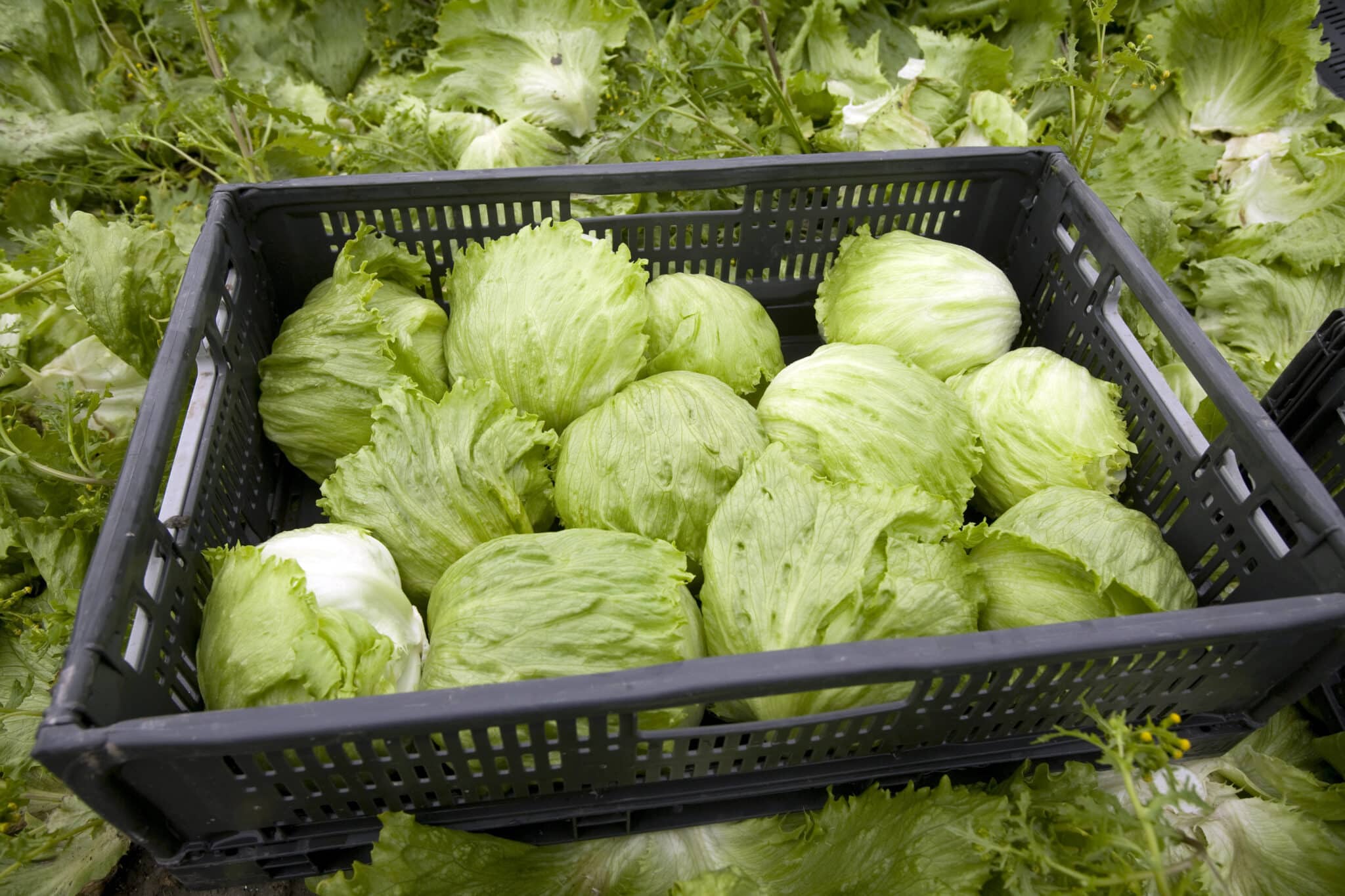

Federal and state investigators are tracking a multistate outbreak of Cyclospora infections tied to shredded iceberg lettuce grown in central Mexico and processed by Taylor Farms de Mexico of Guanajuato (FDA, “Investigation of 9-State Outbreak of Cyclospora Illnesses,” updated July 24, 2026).
The confirmed federal outbreak subset stands at 1,947 people across nine states — Illinois, Indiana, Kansas, Kentucky, Michigan, Ohio, Oklahoma, Pennsylvania, and West Virginia — with at least 98 hospitalizations and no deaths (FDA, July 24, 2026). Illness onsets in that subset run from June 22 to July 20, 2026 (FDA, July 24, 2026).
That figure badly understates the broader picture. Michigan alone has reported more than 8,000 cyclosporiasis cases since late June (Michigan Department of Health and Human Services, via Pritzker Law, July 24, 2026). Michigan health officials have said they cannot certify every illness shares one source, but that the sharp, concentrated spike strongly suggests most belong to the same outbreak (CNN, July 18, 2026). A typical year in the United States brings roughly 200 to 1,000 cases (CBS News, “What to know about Taylor Farms,” July 2026). If the Michigan numbers hold, this becomes the largest cyclospora outbreak on record in the U.S. (CNN, July 18, 2026).
Timeline: notification and response
May 13, 2026 — Earliest illness onset in the original five-state CDC outbreak definition (CDC, “Investigation Update: Cyclospora Outbreak, July 2026”). This date matters: it precedes the recalled distribution window by six weeks.
Mid-June 2026 — A new cyclospora cluster is added to FDA’s CORE outbreak table, signaling an active federal investigation (Food Poisoning Bulletin outbreak tracker, updated July 20, 2026).
July 14–15, 2026 — Michigan’s count passes 3,300. Taco Bell voluntarily pulls limited ingredients at some locations, while stating that officials had not confirmed a link to any specific ingredient or supplier (Medical Daily, July 15, 2026, citing Taco Bell’s statement). FDA Acting Deputy Commissioner Donald Prater confirms investigators are examining multiple produce items including lettuce (Medical Daily, July 15, 2026).
July 16, 2026 — FDA informs Taylor Farms. The agency’s traceback converges on a single supplier of Mexican iceberg lettuce used by Taco Bell locations where sick people had eaten (FDA advisory, July 16, 2026 update). This is the first documented point at which Taylor Farms was told its product was implicated. The company’s own July 17 statement confirms it acted on information FDA provided “yesterday” (Taylor Fresh Foods statement, July 17, 2026).
July 17, 2026 — Taylor Farms de Mexico announces it is voluntarily removing all central-Mexico-sourced iceberg lettuce from the U.S. market and initiates a recall (FDA, July 17, 2026 update; Taylor Farms recall notice, July 17, 2026). Taco Bell stops using lettuce from the supplier the same day (FDA, citing Taco Bell newsroom statement).
July 18, 2026 — FDA reports a lettuce sample from Taylor Farms de Mexico tested positive for Cyclospora (FDA, July 18, 2026 update). The company also suspends production of all products at its central Mexico facility as of this date (Taylor Fresh Foods statement, July 24, 2026).
July 19, 2026 — FDA reverses itself. Laboratory experts re-reviewed the result and concluded it did not represent true amplification; it is reclassified as a false positive (FDA, July 19, 2026 update). Critically, FDA states this does not change the basis for the investigation or the epidemiological data supporting the recall (FDA, July 24, 2026).
July 23, 2026 — A consumer class action is filed in the Northern District of California seeking economic rather than personal-injury damages against Taylor Fresh Foods and Taco Bell Corp. (AboutLawsuits.com, July 2026).
July 24, 2026 — FDA expands the outbreak to nine states (FDA, July 24, 2026).
What Taylor Farms admitted — and how it was worded
The company’s admissions are narrow, factual, and heavily qualified. Read closely, its statements concede logistics while contesting causation.
What it conceded:
- That it recalled all iceberg lettuce grown in central Mexico on July 17, and that the recall was completed with product removed from the marketplace (Taylor Fresh Foods, July 20, 2026 statement).
- That it has stopped sourcing central Mexican iceberg lettuce for the remainder of the growing season (Taylor Fresh Foods, July 20, 2026).
- That it suspended all production at its central Mexico facility as of July 18, and commissioned outside experts for a review of food safety processes there (Taylor Fresh Foods, July 24, 2026).
- The specific product list, lot codes, distribution dates, and states — disclosed in its own recall notice (Taylor Farms recall notice, July 17, 2026).
What it did not concede:
- Causation. The company frames the recall as precautionary, describing it as based on initial information from health officials and taken in an abundance of caution (Taylor Fresh Foods, July 19, 2026).
- Systemic failure. It attributes the traceback to a specific independent farm representing less than one percent of the U.S. iceberg lettuce supply (Taylor Fresh Foods, July 17, 2026; ABC News, July 19, 2026) — language that isolates the problem to a third party rather than its own processing.
- Any brand exposure. Repeatedly: no Taylor Farms branded salads or kits are involved, and its branded kits do not contain iceberg lettuce (Taylor Fresh Foods, July 17 and July 20, 2026).
The rhetorical pivot. After FDA retracted the positive sample, Taylor Farms led its July 19 statement with the assertion that FDA had apologized, and stated that no positive product test result for Cyclospora had been identified (Taylor Fresh Foods, July 19, 2026; Newsweek, July 2026). It repeated the no-confirmed-positives point on July 24, attributing it to FDA (Taylor Fresh Foods, July 24, 2026).
This is accurate but incomplete. FDA explicitly stated the false positive does not undercut the epidemiological case, and that traceback and outbreak data continue to converge on Taylor Farms lettuce from central Mexican growers (FDA, July 24, 2026). Cyclospora is also notoriously difficult to detect in product samples, and by the time an outbreak is identified the implicated food has usually been consumed or discarded — which is why investigators rely on traceback records and patient interviews. Absence of a positive sample is weak exculpatory evidence for this particular parasite.
The 27 states: direct answer
In its own July 17 recall notice, Taylor Farms stated that the shredded iceberg product was distributed June 29 through July 16, 2026 to these 27 states (Taylor Farms recall notice, July 17, 2026; confirmed identically by FDA, July 24, 2026):
AL, AR, CT, FL, GA, IA, IL, IN, KS, KY, LA, MA, MD, MI, MO, MS, NC, NH, NJ, OH, OK, PA, SC, TN, TX, VA, WI
Spelled out: Alabama, Arkansas, Connecticut, Florida, Georgia, Iowa, Illinois, Indiana, Kansas, Kentucky, Louisiana, Massachusetts, Maryland, Michigan, Missouri, Mississippi, North Carolina, New Hampshire, New Jersey, Ohio, Oklahoma, Pennsylvania, South Carolina, Tennessee, Texas, Virginia, and Wisconsin.
Two important qualifications:
- FDA’s total distribution list is 28 states, not 27. FDA adds West Virginia, because recalled Marketside-brand retail product reached Walmart stores there (FDA, July 24, 2026). The company’s 27-state figure covers foodservice distribution; the retail channel adds WV. Recalled Marketside product was sold at select Walmart stores in AL, AR, FL, GA, IN, KS, KY, LA, MO, MS, OK, TN, TX, VA, and WV (FDA, July 24, 2026).
- The list is a floor, not a ceiling. FDA notes distribution is confirmed for the listed states but product may have traveled further, and additional brands, retailers, or channels may yet be identified (FDA, July 24, 2026). The recall also reached consumers in Mexico (FDA, July 24, 2026).
The unresolved gap
The most substantive open question is not concealment but arithmetic.
Taylor Farms recalled product distributed June 29 through July 16 (Taylor Farms recall notice, July 17, 2026). But CDC’s original five-state outbreak definition included illness onsets beginning May 13, 2026 (CDC investigation update, July 2026). Given a typical incubation of about a week, those May exposures occurred well before any recalled lot shipped.
Either the earliest cases belong to a different exposure, or contaminated product moved before the recall window opened. Neither the company nor FDA has publicly reconciled this. Notably, the revised nine-state case definition begins June 22 rather than May 13 (FDA, July 24, 2026) — a narrowing that aligns the outbreak more closely with the recalled distribution period.
FDA has said case counts will keep climbing despite the recall, because confirming whether a sick person belongs to the outbreak can take as long as six weeks (FDA, July 24, 2026).
Prior history and litigation posture
Taylor Farms’ record is central to the plaintiffs’ theory. Public health officials linked a 2013 multistate cyclosporiasis outbreak affecting hundreds of people to Taylor Farms salad mix (ClassAction.org, July 2026; CNN, July 18, 2026). In 2024, the company was identified as the likely source of an E. coli outbreak tied to slivered onions served at restaurants nationwide, which involved hospitalizations and a death (ClassAction.org, July 2026; CNN, July 18, 2026).
Plaintiffs argue this history means Taylor Farms knew or should have known its ready-to-eat produce carried real contamination risk and owed a correspondingly higher standard of care (FindLaw, July 2026). This is the legal channel through which “what they knew” is actually being litigated — as constructive knowledge from prior outbreaks, not as concealment of a specific 2026 warning.
Individual personal-injury suits have been filed, several by Ohio plaintiffs who ate Taco Bell meals containing iceberg lettuce and subsequently tested positive and other sin Michigan. The filing attorney, Ron Simon, has stated that many more lawsuits will likely follow, including in other states like Kansas and Misouri.
Separately, Newsweek reported on the company’s political giving, including a $1 million March 2025 contribution by Taylor Fresh Foods to MAGA, Inc., a super-PAC supporting President Trump, alongside a $2,500 donation to the Western Growers Political Action Committee (Newsweek, July 2026). No reporting has connected these contributions to the handling of this investigation.
Bottom line
If what Taylor Farms says is true, they acted within roughly 24 hours of FDA notification — acceptable by recall standards. The available record contains no evidence it was warned earlier and sat on it. That said, what it has admitted is procedural: it shipped the lettuce, to those states, in that window, and it pulled it. What it has resisted admitting is causal responsibility, and its post-July 19 messaging has leaned hard on a lab retraction that FDA expressly said changes nothing about the underlying case (FDA, July 24, 2026). The company’s confidence in its food safety systems (Taylor Fresh Foods, July 24, 2026) sits uneasily beside a decision to suspend all production at the implicated facility and commission an outside top-to-bottom review.
The investigation remains open (FDA, July 24, 2026).
